
Clothes hangers and clothes racks – how do you choose them?
-

How to choose hangers and racks for a clothes shop – tips for shoppers
A clothes hanger seems like a simple detail until it starts changing the way the product looks. The same shirt, jacket or skirt can look neat and more expensive — or lose its shape and appear cheaper — simply because the wrong hanger was used.
In a clothing store, hangers and clothing racks are part of the product presentation. They help keep the sales floor tidy, make sizes easier to find, make the assortment clearer and support the feeling of a well-organised boutique. That is why the cheapest option is not always the best choice. Thin, flimsy or mismatched hangers can simplify the overall look of the store and make the clothing itself seem lower in quality.
A good hanger does not necessarily have to be expensive. In our experience, what matters more is whether it suits the product: its width, material, strength, colour, shoulder shape and fastening method. This is the best way to look at the range offered by the Galsas online store: standard clothes hangers, clip hangers, wall-mounted hanging solutions, chains and hooks, size markers, and racks and holders for complementary products.
A tidy retail area with matching hangers, a clothing rack and coordinated outfits:
a clear example of order, consistent style and easy product navigation.
1. Start by deciding what the hanger needs to doBefore buying, do not start with the material or the price. First define the task: are the hangers for an attractive sales-floor display, dense storage on a rack, trousers and skirts, children’s clothing, accessories or a stockroom?
- For the main sales area, a consistent look, strength and ease of use are essential. Based on the experience of Galsas customers, it is usually easiest to start with one basic hanger series and then add specialist models for trousers, skirts or accessories.
- For the shop window and entrance area, visual consistency matters most: matching hangers, the correct width and a calm colour. This is where the customer forms a first impression, so random and brightly mixed hangers are best avoided.
- Trousers, skirts and shorts need clip hangers so that the garment hangs straight and does not slip.
- Knitwear and slippery fabrics benefit from non-slip elements or a softer shoulder shape.
- For the stockroom, a more practical and economical option may be enough, but it still needs to support the weight of the garments.
If the store sells several clothing categories, do not try to cover everything with a single hanger model. For these products, we would not recommend “universal” hangers for every garment: they rarely work equally well for shirts, trousers and children’s clothing. A simple system is more practical: standard hangers for tops, separate clip hangers for trousers and skirts, children’s hangers for the kids’ department, size markers to guide customers, and a few wall-mounted or additional holders for accessories.
2. What solutions are available in the Galsas online storeIn the Galsas online store catalogue, hangers are presented not as a single product but as a complete group of solutions for selling clothing and complementary items. Based on the experience of Galsas customers, this is convenient because you can choose not only the hangers themselves, but also the racks or systems they hang on, the way sizes are marked and the way accessories are displayed next to clothing.
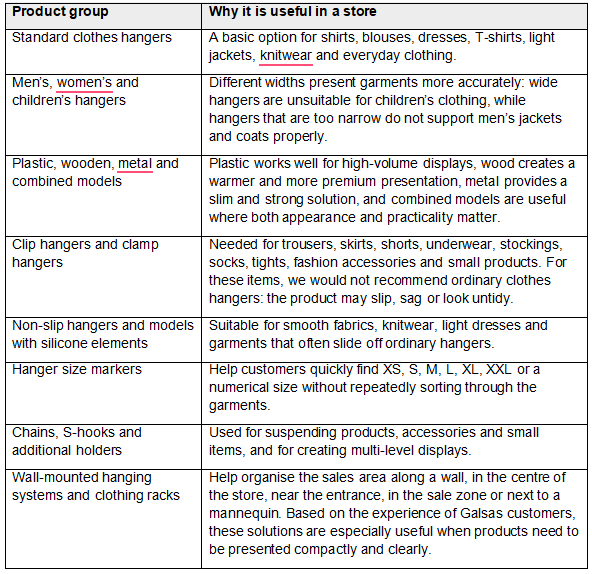

Plastic, wooden, metal and non-slip hangers, together with clip hangers and size markers, show the breadth of the Galsas range.
3. How to choose hangers for specific garments
The most reliable way to choose is to start with the garment. In our experience, this is where mistakes most often occur: a buyer selects one attractive or inexpensive model and later discovers that trousers need clips, children’s clothing needs a narrower width and light dresses need non-slip elements. A hanger should do more than simply hold clothing: it should preserve the shape, avoid stretching the fabric, prevent creases and allow the customer to remove the garment from the rack easily.
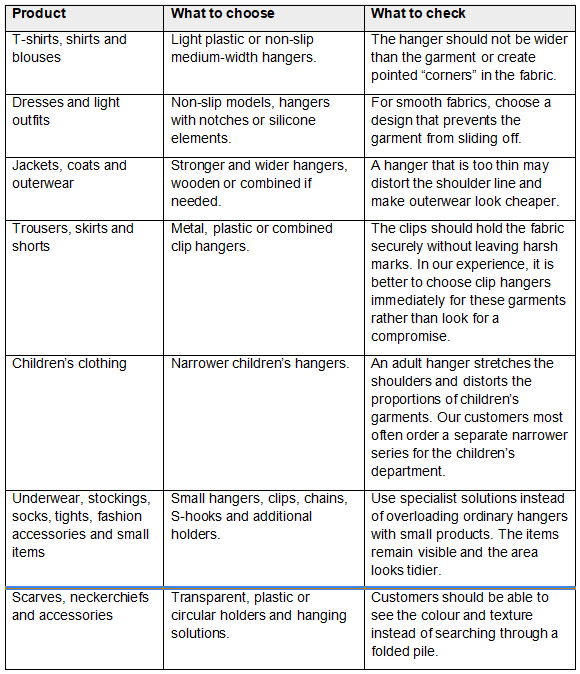
On the sales floor, avoid placing hangers of different colours, widths and materials together without a clear reason. Even when each hanger is suitable on its own, the combination creates visual noise. Our customers most often order one main series for the basic area and add specialist models only where they are genuinely needed: for trousers, skirts, children’s clothing or accessories. The clothing then looks calmer, while the store appears more refined and organised.
4. Which option suits your storeThe practical scenarios below can be used as a quick guide before ordering.
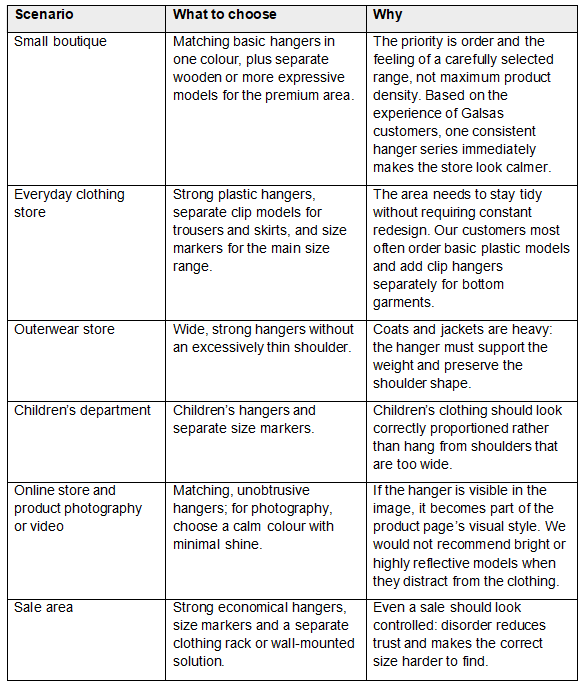

Practical solutions for different zones: matching hangers for basic clothing,
clip hangers for trousers and skirts, children’s hangers and accessory holders.
5. What to check when buying clothes hangers
Before ordering, check several practical details. They may seem minor, but they determine whether the clothing will continue to look neat every day.
5.1. Hanger width
The width should match the garment. Women’s blouses and dresses usually need narrower models, while men’s shirts, jackets and outerwear need wider ones. If the hanger is too wide, it stretches the shoulders. If it is too narrow, the garment sags and looks untidy.
5.2. Strength and garment weight
Simple plastic hangers are sufficient for light T-shirts and blouses. Coats, jackets, suits and dense knitwear need a stronger model. For these products, we would not recommend the thinnest hangers: they may bend, distort the shoulder line and make the garment look cheaper. In a store, a hanger is used every day: it is removed, returned to the rack, moved along the rail and sometimes overloaded. A weak construction quickly loses its shape and appearance.
5.3. Shoulder shape
A well-shaped shoulder helps the garment hang evenly. This is especially important for jackets, coats, shirts and knitwear. A thin hanger may be useful for a dense display, but it does not always present an expensive or heavy garment well.
5.4. Clips and fabric protection
Choose clip hangers for trousers and skirts. If the fabric is delicate, the clips should not leave harsh marks. This is not a minor detail in a store: the customer should see the garment in sale-ready condition, not with creases caused by the display.
5.5. Non-slip elements
Smooth fabrics, light dresses, thin-strap tops and knitwear often slide off ordinary hangers. A non-slip coating, silicone inserts or special notches help keep the rack tidy and reduce the number of garments that fall or bunch together on one side.
5.6. Colour and a consistent style
For most stores, it is better to use one basic hanger colour throughout a zone. In our experience, our customers most often order black, transparent or neutral plastic models for the main display, while wooden or more expressive hangers are reserved for the premium area. Black hangers look organised and practical, transparent hangers compete less with the clothing, and wooden hangers create a warmer, higher-quality impression. The main rule is not to mix everything together without a reason.
5.7. Hanger size markers
Size markers are a small detail that makes choosing much easier. Customers find the correct size faster, staff can maintain order more easily and the area looks more professional. They are particularly useful in stores with a wide size range, children’s clothing, trousers, dresses and seasonal outerwear.
5.8. Compatibility with clothing racks and wall-mounted systems
Check how the selected hangers will work with the clothing rack, wall-mounted system, chain or S-hook. The hook should move freely, avoid catching or scratching the finish, and allow the customer to remove the garment easily.
6. Availability, price and buying confidently from a direct supplierWhen buying retail equipment, do not look only at the price shown on the product page. It is important to understand who actually holds the stock, who is responsible for shipping and how long the order will take to arrive.
Many products are now sold through marketplaces and intermediaries using a dropshipping model. For the buyer, this may provide a familiar interface and a small additional layer of protection, but there is another side to the arrangement: the price is often higher and the delivery time less predictable. Marketplace fees, the intermediary’s margin and the absence of a local warehouse do not disappear — they are built into the product price. Buying directly from the supplier can therefore make a noticeable difference, approximately 10–17%, especially when ordering a batch of hangers, size markers or retail equipment.
The Galsas online store focuses on transparent retailing: customers can see the range, check availability and choose suitable products without the feeling that they are being sold stock that may not actually exist. In our experience, this is particularly important for a store: when opening a department, reorganising the sales floor or quickly replenishing one hanger type, clear stock information makes purchasing easier to plan and reduces unpleasant surprises.
The Galsas online store also states fast delivery — usually within 1–3 working days, depending on the destination country. This is useful for stores that need equipment by a specific date: before opening, launching a new collection, starting a sale or reorganising the store for a new season.
It is also worth checking the seller’s reputation. Reliable suppliers who value customer trust are not afraid to show reviews and link to their rating.You can check the Galsas online store profile on Google here:
https://business.google.com/v/galsas/017945840068792098242/1a6c/_/rev/


7. How to use clothes hangers and clothing racks on the sales floor
Even good hangers will not solve the problem if products are arranged without a system. The customer should understand where to find the new collection, sizes, trousers, children’s clothing, accessories and sale items.
Entrance area
Near the entrance, show a limited selection: a seasonal item, a new arrival or a complete outfit. Do not place an overcrowded clothing rack directly in the walkway. Customers should be able to enter, stop and look at the products comfortably.
Main sales area
A consistent hanger system is particularly important here. When similar garments are displayed on matching hangers, the store looks calmer. Size markers can be placed next to the products so that customers find the correct size more quickly.
Centre of the store
An “island” made from one or more clothing racks works well in the centre of the store. Based on the experience of Galsas customers, this area is especially useful for new arrivals, seasonal products and coordinated outfits. However, the centre must not turn into a stockroom. Leave enough space for customers to move around, avoid overcrowding the rack and display only the products you genuinely want to highlight: a seasonal range, a new collection, complete outfits or clear basic pieces.
Walls and side areas
Wall-mounted hanging systems are useful for displaying a small product group: accessories, knitwear, stockings, socks and tights, fashion accessories, scarves, belts or coordinated sets. They save floor space and turn the wall into a useful sales area.
Sale area
A sale should not look like a random pile of clothing. A separate clothing rack, matching hangers, size markers and a clear promotional sign help the customer make a decision more quickly.
A well-organised clothing rack with matching hangers, size markers and clear product grouping.
8. Simple display layouts for a store
A store can begin with several simple display layouts. They are easy for customers to understand and do not require a complicated redesign.
- “One consistent line”: the entire category is displayed on matching hangers in one colour. Suitable for basics, shirts, dresses and knitwear.
- “Top + bottom”: hangers for blouses, shirts or jackets are placed next to a separate group of clip hangers for trousers and skirts.
- “Size navigation”: each group uses XS–XXL markers or numerical sizes. Suitable for broad size ranges and children’s departments.
- “Complete outfit”: a clothing rack next to a mannequin or front-facing display carries the same garments shown in the outfit.
- “Accessory nearby”: hooks, chains, racks or holders for complementary products are placed next to the clothing — for scarves, belts, gloves, bags or fashion accessories.
- “Organised sale”: a separate clothing rack, matching hangers, size markers and an information holder with the promotion terms.
9. What to avoid
Hanger-related mistakes rarely look serious on their own, but together they quickly reduce the overall quality of the store.
- using too many different hangers in one area without a clear idea;
- hanging heavy outerwear on hangers that are too thin;
- using adult hangers for children’s clothing;
- displaying trousers and skirts without clips when the garments sag or slip;
- overloading a clothing rack so that customers cannot remove a garment comfortably;
- not using size markers where there are many sizes and repeated models;
- mixing accessories with clothing without hooks, holders or a separate display system;
- buying the cheapest hangers for an area where more expensive clothing is sold.
The main rule is simple: the hanger should not compete with the product. It should support the shape, help customers find the correct size and keep the display tidy.
10. Quick points to check before ordering- What products will hang on these hangers: shirts, dresses, jackets, trousers, skirts, children’s clothing, underwear or accessories?
- Does the hanger width suit the garment size?
- Will the material support the weight of the product?
- Do you need clips, non-slip inserts or a trouser bar?
- Will the hangers be used on the sales floor, in a window display, for product photography or in a stockroom?
- Do you need one consistent colour throughout the area?
- Do you need XS–XXL size markers or numerical sizes?
- Will the selected hangers work with your clothing rack, wall-mounted system or suspension system?
- Is the required quantity currently in stock?
- Are you buying from a direct supplier that clearly shows its range, delivery times and reputation?
11. Frequently asked questions before buying
Which hangers are best for a new store?For most stores, it is easiest to begin with one basic hanger series for the main clothing range and add clip hangers separately for trousers and skirts. Based on our customers’ experience, this system is clear for buyers and convenient for staff.
Do I need expensive hangers throughout the store?
Not always. A more expensive hanger is worthwhile where it genuinely affects the appearance of the product: outerwear, jackets, dresses, the premium area or the shop window. A practical model can be used in the stockroom and for dense basic displays, but it still needs to be strong.
Should different hanger colours be mixed?
They can be mixed, but it should be done deliberately. For example, the main area may use black or transparent hangers, while the premium area uses wooden ones. A random mix of colours usually makes the store look less organised.
When are size markers useful?
Size markers are especially useful when you have many identical models, a broad size range, children’s clothing or a sale area. Customers find the correct size faster and staff can maintain order more easily.
What should I buy together with the hangers?
Together with hangers, our customers most often order size markers, clips, S-hooks, chains, wall-mounted hanging solutions, clothing racks and information holders. This makes it possible to create a complete sales-area system rather than buying unrelated individual products.
ConclusionStore hangers should be selected not as disposable accessories, but as part of the product presentation. A good hanger system helps clothing look neater, makes sizes easier to find, gives the sales floor a clearer structure and supports the overall standard of the store.
Strong plastic or non-slip models are suitable for basic clothing. Outerwear and more expensive categories benefit from stronger and visually higher-quality options. Trousers, skirts and accessories need separate clip hangers, hooks, chains or specialist holders. Size markers help organise the assortment and make choosing easier for the customer.
The Galsas online store offers everything needed to create a complete sales-area system: standard clothes hangers, clip models, children’s and adult sizes, non-slip options, size markers, wall-mounted hanging solutions, chains, S-hooks, clothing racks and holders for complementary products. This is more convenient than buying random individual items because the whole system can be matched to the store’s style and real sales needs.
A complete retail solution with matching hangers, clothing racks, size markers and accessories.


