
Opening a clothes shop: planning the shop floor, display stands and retail systems
-

Clothing shop – our advice: How to plan your shop floor effectively and choose clothes racks
A clothing rack may look like simple equipment: put up a rail, hang the products, and the area is ready. In practice, it is a little more complicated. The same collection can look neat, spacious and more expensive — or, on the contrary, like temporary storage. Very often, the difference is not the clothing itself, but how the racks are chosen and placed.
This article covers stationary clothing racks, mobile racks on wheels, wall-mounted solutions and profile retail display systems.
The main idea is simple: choose the rack together with the store layout, not separately from it. Where will the entrance zone be? Where will the new collection stand? Where will the sale area be? Where should customers move freely, and where can the display be denser? If you answer these questions in advance, the purchase will be much more accurate.
In our experience, a good rack does not have to be the most expensive one. But a rack that is too light, unstable or randomly chosen can quickly spoil the look of the sales floor. This is especially true if the store sells not only basic clothing, but also jackets, dresses, outerwear or seasonal collections. For such products, we would not advise choosing equipment only by the lowest price.
Main retail floor scheme: entrance zone, central rack, wall area and free aisles.
1. First, define the task of the rack
Before buying, it is better not to start with colour, price or size. First, understand what job the rack should do in the store.
Based on the experience of Galsas customers, mistakes most often start exactly here: a buyer takes one “universal” rack for everything, and later it turns out that the centre of the store needs one type of construction, the wall needs another, the stockroom needs a third, and a mobile rack on wheels is more convenient for sales and temporary displays.- For the main selling area, you need a stable rack that can hold the weight of products every day and withstand frequent movement of hangers.
- For the entrance zone, choose a neater and not overly loaded solution: this is where the customer gets the first impression of the store.
- For the centre of the store, it is important to keep aisles open and not place a rack where it blocks customer movement.
- For seasonal rearrangements, sales or temporary displays, a mobile rack on wheels is often more convenient.
- For walls and small stores, wall-mounted solutions or a profile retail display system work well.
- For a boutique, strength is not the only point: the rack should support the level of the product, not make it look cheaper.
If the store is small, you do not need to buy a lot of equipment at once. It is often better to build a clear base: 1–2 stationary racks, one wall-mounted solution or a profile system along the wall, and one mobile rack for rearrangements. Later, you can add elements for a season, sale or new collection.
2. What types of clothing racks are available
In the Galsas online store, clothing racks are presented as several different solutions, not as one universal model. This is the right approach: a retail floor is not made of one single line of hanging space. In one place you need stability, in another mobility, elsewhere a working wall, and sometimes a modular system that can be reconfigured.
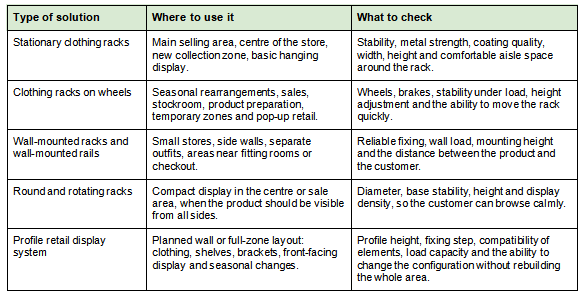

Main clothing rack options: stationary rack, rack on wheels, wall-mounted solution and profile system.
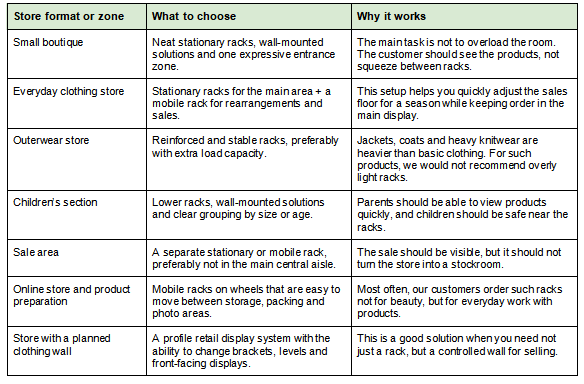
3. How to choose a rack for your store format
The easiest way to choose is to start from the store format. This helps you understand which rack is needed first and which solutions can be added later.
4. Stationary racks: the base of the retail floor
Stationary racks are the base of the retail floor. They are suitable for permanent displays, new collections, basic clothing, dresses, jackets, outerwear and seasonal products. Their job is to hold products every day and look calm, without a temporary feeling.
In our experience, it is better to choose a stationary rack with a small reserve of strength. Even if today it holds light pieces, tomorrow it may carry heavy knitwear, jackets or a sale batch.
A stationary rack is a good choice where the equipment does not need to be moved all the time. It creates the “skeleton” of the store: customers understand where the main collection is, where separate groups are, where the aisles are and where to browse.- For the entrance zone, choose not the largest rack, but the neatest one: it is better to show fewer products, but more clearly.
- In the centre of the store, one strong rack or a small island of 2–3 racks works well if the aisles remain open.
- For outerwear, choose a more stable construction: a thin rack can look uncertain and quickly lose its visual quality.
- For a boutique, racks should come from the same series or at least share one style. A random mix of equipment visually cheapens the sales floor.

A stationary rack in the centre of the sales floor with neat hanging and free space around it.
5. Racks on wheels: when flexibility matters
A mobile rack on wheels is not only a stockroom solution. In a store it is useful wherever the layout changes often: new collection, seasonal display, sale, fitting area, product photography or preparing products for shipping.
Most often, our customers order mobile racks when they need to change the retail space quickly without dismantling equipment. Today the rack stands near the entrance with a new collection, tomorrow near the checkout, and the day after in the sale area.
But a mobile rack should not always replace a stationary one. If the rack will constantly stand in the central zone and hold heavy clothing, it is better to consider a more stable stationary option.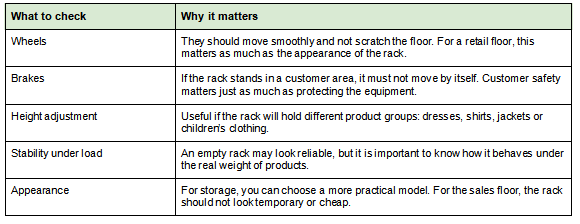
For products such as coats, heavy jackets and dense knitwear, we would not recommend overloading a light mobile rack. It is convenient for movement, but it should not become unsafe or look careless in the eyes of customers.
6. Wall-mounted racks: when you need to free the floor
Wall-mounted racks and wall-mounted rails work well where floor space is limited. They free up the floor, turn the wall into a working display area and help show the product at the customer’s eye level rather than deep inside the store.
Based on the experience of Galsas customers, wall-mounted solutions are often chosen for small stores, side zones, separate outfits, entrance areas or sections near the fitting room. This is a good way to use the wall without installing an additional floor rack.
The main point is that a wall-mounted solution requires correct fixing. You need to consider the wall type, load, mounting height and how comfortably the customer can take the product.- Do not place products too high: customers should be able to reach the item easily.
- Do not make the wall too dense: if everything hangs without breathing space, products are harder to read.
- Use a wall-mounted solution in the entrance zone as an accent, not as a stockroom wall.
- If the wall is weak or the finish is complicated, think through fixing and load in advance.

A wall-mounted solution frees the floor and helps present clothing neatly along the wall.
7. Profile retail display system: when you need a full layout, not just one rack
A profile retail display system makes sense when the store wants not just to place several racks, but to build a more thought-out wall or zone. This solution is useful when you need to change levels, add brackets, create front-facing displays and combine hanging space with shelves.
Simply put, an ordinary rack answers the question “where to hang clothes”. A profile system answers the question “how to organise the whole wall or part of the sales floor”.
In our experience, a profile system is especially useful for stores that work with different seasons and often change their display. Today you can show outerwear, tomorrow dresses, then a sale or a new collection. At the same time, you do not need to completely change the equipment every time.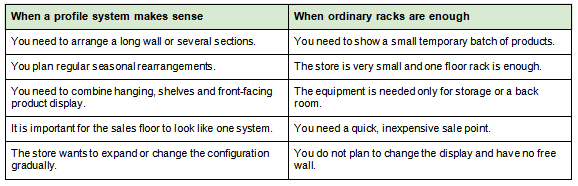
Most often, our customers order a profile system not as a replacement for all racks, but as a neater solution for the wall. Floor racks remain in the centre and seasonal zones, while the profile system helps organise the store perimeter.

A profile retail display system helps turn a wall into one organised selling zone.
8. How to compose a retail floor with clothing racks
Even a good rack can work poorly if it is placed in the wrong spot. The store layout should help the customer move calmly: enter, see the main offer, go to the right category, take the product and reach the fitting room or checkout.
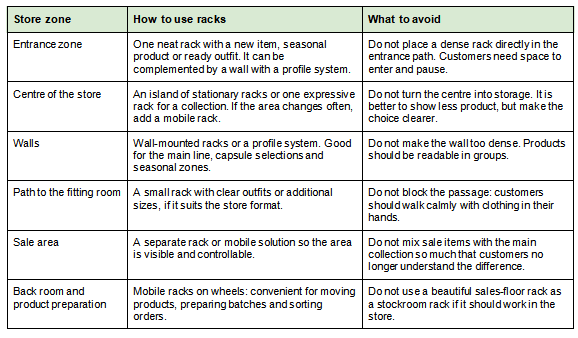
Based on the experience of Galsas customers, a simple logic works best: walls are for systematic display, the centre is for what should be shown now, and mobile racks are for changes and seasonal tasks.
If the sales floor is small, do not try to place many racks. Sometimes one well-chosen stationary rack and a neat profile system on the wall bring more value than five random constructions in the aisles.
An example of a sales floor where the central rack, walls and aisles work together.
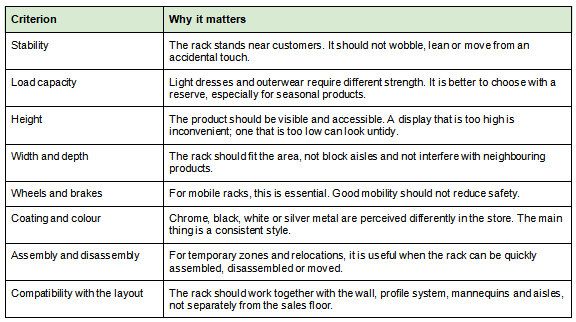
9. What to check before buying a rack
10. Availability, price and honest buying from a direct seller
When buying clothing racks, it is important to look not only at the price. For a store, delivery time, availability, quality and a clear seller matter. This is especially important if the equipment is needed for an opening, a new collection or a seasonal rearrangement.
Today, many products are sold through marketplaces and intermediaries. Buying on a marketplace may be convenient and can sometimes give the buyer an additional feeling of protection. But this model has another side: the marketplace commission and the intermediary’s work are often included in the price. With direct purchase from a supplier, the difference can be noticeable, especially when a store orders not one rack, but several elements for the retail floor.
The Galsas online store focuses on open trading: the buyer sees the assortment, can assess availability and choose the right items without the feeling that someone is selling “air”. In our experience, this is especially important for retail equipment: racks are often needed not abstractly “sometime”, but by a specific date.
It is also worth checking the seller’s reputation. Solid and honest suppliers who value customer recognition are not afraid to show reviews and attach a link to their Google rating.Click on the link below to view reviews and ratings for ‘Galsas’ on Google:
https://business.google.com/v/galsas/017945840068792098242/1a6c/_/rev/


A product card helps quickly check availability, specifications and buying conditions.
11. What to avoid
Mistakes with racks rarely look critical on their own. But together they quickly damage the impression of the store and make it harder for the customer to browse products calmly.
- buying a rack only by the lowest price, without considering load and stability;
- placing too many racks in the centre of the store and blocking aisles;
- using a mobile rack as a permanent main zone for heavy clothing if it is not designed for that;
- hanging too much product on one rack — the customer cannot see the assortment and cannot easily remove an item;
- making the entrance zone too dense and stockroom-like;
- buying a wall-mounted solution without checking the wall and fixing method;
- mixing different equipment styles without one clear idea;
- forgetting about a profile system where the task is not one rack, but a whole wall;
- not leaving space for fitting, customer movement and staff work.
The main rule is simple: a rack should help the customer see the product and move around the store. If the equipment gets in the way, blocks the aisle or makes the store look like storage, it works against sales.
12. Quick pre-purchase check- Where will the equipment stand: near the entrance, in the centre, by the wall, in the sale area or in the back room?
- What clothing will hang on it: light, outerwear, children’s, seasonal or sale products?
- Do you need a stationary rack or a mobile rack on wheels?
- Do the wheels need brakes?
- Is the stability and load capacity enough for your products?
- Does the rack height suit the customer and the store format?
- Does the rack block aisles?
- Should you use a wall-mounted solution to free the floor?
- Is a profile retail display system appropriate for the wall or future rearrangements?
- Will the equipment look consistent with the rest of the sales floor?
- Are the required items available from a direct supplier?
- Can you check the seller’s reputation and delivery time?
13. Common questions before buying
What is better to choose first: a stationary rack or a rack on wheels?
If the rack will stand permanently in the sales floor and hold the main collection, it is better to start with a stationary one. If the layout changes often, products need to be moved or the equipment is needed for order preparation, a mobile rack on wheels is more convenient.
Can I use only mobile racks?
Yes, but it is not always the best option for the store’s appearance. Mobile racks are convenient, but the main selling area usually looks calmer when it includes stable stationary solutions.
When do I need a wall-mounted rack?
When you need to free the floor, use a side wall or show a small group of products. This is especially useful in small stores and narrow zones.
When should I choose a profile retail display system?
When you need to arrange a full wall, change displays by season, use different levels and gradually develop the store layout. This is not a solution for one random point, but for a system.
Can racks and a profile system be combined?
Yes. Very often this is the most convenient option. Walls work through the profile system, while the centre of the store uses stationary or mobile racks. This makes the store look more organised.
Why should racks not be overloaded?
Customers should be able to browse products easily. When a rack is overloaded, items are harder to see, sizes are harder to find, and the zone begins to look cheap and chaotic.
Conclusion
Clothing racks should be chosen not as a separate metal construction, but as part of the retail floor. A good rack helps present products, keep order, guide customer movement and support the level of the store.
For permanent displays, stationary racks are suitable. For seasonal rearrangements, product preparation and temporary zones, mobile racks on wheels are useful. For small stores and side zones, wall-mounted solutions are convenient. And if you need to arrange a full wall or flexibly change the layout, a profile retail display system is worth considering.
In the Galsas online store, you can choose clothing racks for different tasks: stationary racks, mobile racks, wall-mounted solutions and elements of a profile retail display system. This approach is more convenient than buying random items one by one: the equipment can be connected to the real store layout, products and sales tasks.


